

FALL PROTECTION EQUIPMENT STANDARDS AND REGULATIONS
PERSONAL SAFETY
“3 meters” required, under section 346 of the Occupational Health and Safety Regulations (OHSR):
FALL PROTECTION DEVICES:
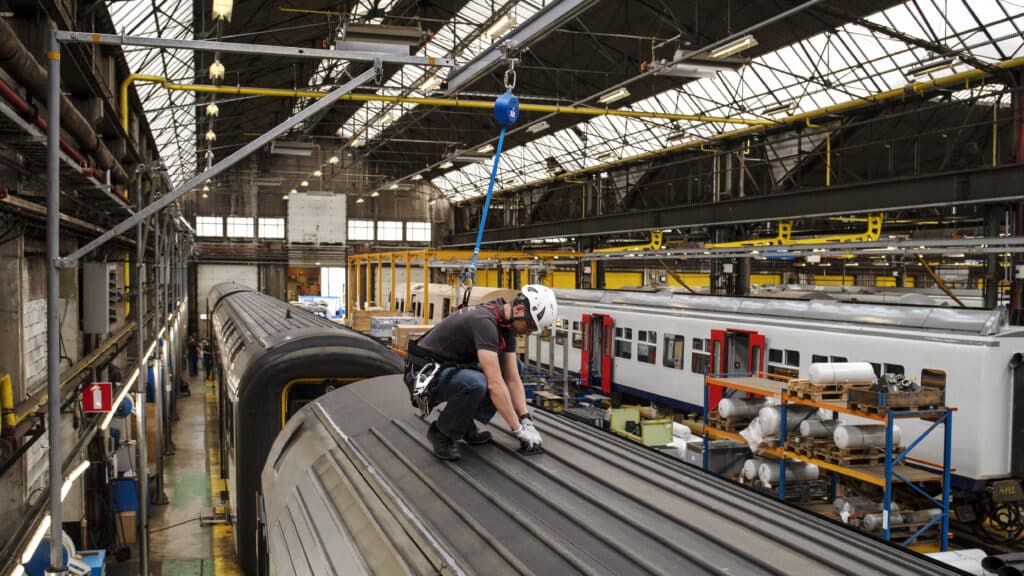
Wearing a safety harness is mandatory for any worker exposed to a fall of more than 3 meters from their work position, unless the worker is protected by another device providing equivalent safety or by a safety net, or when they are only using a means of access or exit.
This “3 meters” is not the only requirement of the RSST on fall prevention. Article 324 deals with work involving a risk of falling:
Work involving a risk of falling:
Maintenance, repair, or unblocking work involving a risk of falling must be carried out using scaffolding, work platforms, walkways, portable ladders, safety harnesses, or other appropriate equipment.
COLLECTIVE SECURITY
GUARDRAILS – ANCHORS – NETS
The guardrail must be designed to withstand a static load of approximately 1 to 1.5 kN vertically and 0.45 kN horizontally, simultaneously.
2.9.3. Safety net:
When a safety net is installed, it must:
- be positioned so as to prevent a person from falling more than 6 m in free fall;
- be of sufficient size to catch a person in the event of a fall;
- be able to withstand a mass of 115 kg falling from a maximum height of 6 m with a safety factor of 3;
- be flexible enough to “cushion” and hold a person in the event of a fall;
- resist the effects of atmospheric agents;
- be free of debris; be made of mesh measuring approximately 150 mm × 150 mm;
- be installed in such a way that, when in use, a person who falls into it cannot hit an obstacle above or below the net or be hit by any object.
Anchors that comply with EN 795 are accepted on construction sites in Quebec. Here is a copy of the regulatory article:
The anchor must be certified for a minimum breaking strength of 18 kN (RSST, Art. 348).
Safety Code for Construction Work (CSTC) RRQ, c. S-2.1, r.4
Art. 2.10.15. Anchoring system:
The fall-arrest connecting device of a safety harness must be secured to:
- a single anchor point with one of the following characteristics:
a) a breaking strength of at least 18 kN;
b) designed and installed in accordance with an engineer’s plan in compliance with CSA Standard Z259 Design of Active Fall-Protection Systems, and having one of the following characteristics:
i. a strength equal to twice the maximum fall-arrest force as certified by an engineer;
ii. certified in accordance with EN 795 Personal Fall Protection Equipment Against Falls – Anchoring devices published by the European Committee for Standardization or with CAN/CSA Standard Z259 Anchorage Connectors.
2. a flexible continuous anchorage system (horizontal lifeline) having one of the following characteristics:
a) in compliance with the following minimum standards:
i. a steel cable with a minimum diameter of 12 mm released at a minimum angle of 1 vertical to 12 horizontal, or 5° to the horizontal;
ii. a maximum distance of 12 m between end anchors;
iii. end anchors with a breaking strength of at least 90 kN;
iv. not to be used by more than two workers at a time.
b) designed and installed in accordance with an engineer’s plan in compliance with CSA Standard Z259.13 Flexible Horizontal Lifeline Systems and CSA Standard Z259.16 Design of Active Fall-Protection Systems;
3. A rigid continuous anchorage system designed and installed according to an engineer’s plan in accordance with CSA Z259.16 Active Fall Protection System Design.
However, the Occupational Health and Safety Regulations (OHSR), applicable outside construction sites, do not contain a similar reference, and there is no indication that this will change in the near future. Generally, the regulations refer to Canadian standards. Nevertheless, equivalencies may be accepted where appropriate.